
What is a mechatronic gearbox?
A mechatronic unit is the part of a dual-clutch gearbox that brings its electronics and hydraulic controls together. In a Volkswagen DSG or Audi S tronic transmission, it helps decide when to change gear and controls the actions that make the shift happen. If you are searching for a mechatronic specialist in Bristol, understanding what the unit actually does is a useful starting point: a gearbox symptom does not, by itself, prove the mechatronic unit has failed.
Gearbox warnings, delayed engagement, harsh changes or a loss of particular gears deserve proper investigation. At Trescothick Automotive in Brislington, we provide DSG and S tronic diagnosis. We use diagnostic information alongside practical testing to establish whether the cause is electronic, hydraulic, clutch-related or mechanical before recommending a repair. You can read about our DSG and S tronic mechatronic diagnostics in Bristol if you need help with a current fault.
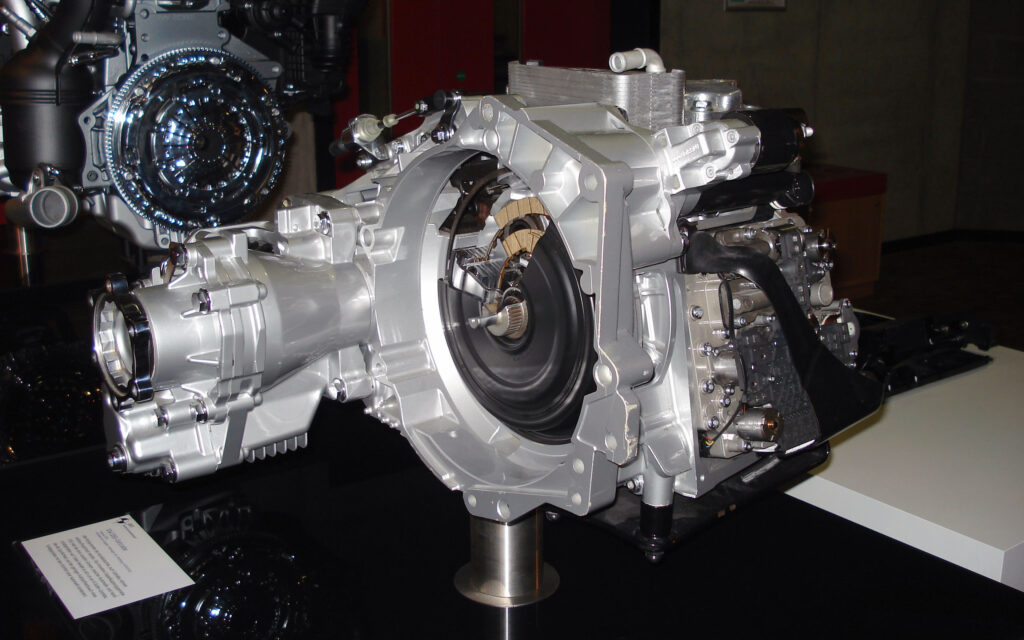
Inside a mechatronic DSG gearbox
Image: Matti Blume · CC BY-SA 3.0 · Unmodified

What Does a Mechatronic Unit Do?
“Mechatronic” describes the meeting of mechanical engineering, electronics and control systems. In a DSG gearbox, the control unit interprets information such as vehicle speed, engine demand, gear position and gearbox conditions. Its hydraulic side then operates valves and actuators involved in selecting gears and managing the clutches. The exact hardware and arrangement vary by transmission.
A dual-clutch gearbox has two clutch paths. One can transmit drive while the next gear is prepared on the other. During a change, the control system coordinates the clutches so drive passes from one path to the other. That is why the condition of the clutches, hydraulic supply, sensors and mechatronic controls all matters. A problem anywhere in that chain can change how the car shifts.
How Did DSG Mechatronics Develop?
Where Did the Word “Mechatronic” Come From?
The story begins well before the first DSG. Yaskawa’s own history says its engineer Tetsuro Mori applied to register “mechatronics” in 1969, combining mechanism and electronics; the trade mark was registered in 1972 and later released for general use. There is an intriguing wrinkle: Wikipedia’s history of mechatronics notes an earlier printed use of the word in a 1951 advertisement. It is therefore safer to credit Yaskawa with popularising the term than to claim nobody had ever printed it before.
In engineering, mechatronics is much broader than a gearbox. It describes a system in which mechanical parts, electronics, sensors and control software work together. A modern DSG control assembly is a vivid example: its controller makes a decision, valves and hydraulics carry it out, and sensors report what happened. If the reported result differs from the request, the system may adapt, record a fault or protect the transmission. The familiar garage phrase “the mechatronic” refers to a particular gearbox assembly, while the broader word describes an entire way of designing machines.
Before DSG: Dual-Clutch Ideas in Motorsport
The dual-clutch idea predates Volkswagen’s road-going DSG. Porsche records development work from around 1980 and racing use of its PDK system in the 1980s, including a victory for a PDK-equipped 962 C at Monza in 1986. That is useful history for understanding why uninterrupted drive during a gear change attracted engineers. It does not make a Porsche PDK the same gearbox as a Volkswagen DSG; the systems have separate designs and applications.
2003: The First Volkswagen DSG
Volkswagen dates the introduction of its first production DSG to the Golf R32 in 2003. That early six-speed gearbox brought dual-clutch shifting to a road-going Volkswagen. The central challenge was to coordinate two clutch paths and gear selection quickly enough for smooth everyday use. The mechatronic control system was key to making that possible.
2007: Seven Speeds and Dry Clutches
Volkswagen says series production of its seven-speed DSG began at the end of 2007, initially in a Golf TSI application. Its dry-clutch design served a different set of engine and torque requirements from the earlier wet-clutch gearbox. The control system still had to coordinate gear changes, but the hardware and the way a fault presents could differ. This is why “DSG mechatronic” is not a single interchangeable part or a single diagnosis.
Later DSG and Audi S tronic Designs
Further transmissions added different gear counts, clutch arrangements, torque capacities and layouts. Audi uses the S tronic name for certain dual-clutch transmissions; the precise gearbox still depends on the vehicle. A DQ200, DQ250, DQ381 or DQ500 cannot be treated as the same unit, and an Audi DL501 / 0B5 is a different longitudinal design again. Before discussing a repair, we identify what is actually fitted to the car.
The Clever Idea—and Its Limits
Think of a DSG as two gear paths sharing the job. One path can drive while the other prepares a likely next ratio. The control system then manages the handover between clutches. This is often described as an instant change, but the gearbox cannot know the future: a sudden request for a lower gear, a hill or a change of throttle can make the preselected ratio the wrong one. Smoothness depends on choosing well and controlling the clutch handover, not merely on having two clutches. Volkswagen’s technical explanation of DSG describes the mechatronic module as housing the electronic control unit, sensors and hydraulic actuators in a compact assembly.
This also explains why a gearbox may drive normally in one circumstance and misbehave in another. The same car can respond differently to a cold start, a manoeuvre into Reverse or an overtaking downshift. Those details are useful evidence for a technician; none identifies a failed part on its own.
Why Did Dual-Clutch Gearboxes Need Mechatronics?
A conventional manual gearbox depends on the driver to choose a gear and operate a clutch. A dual-clutch transmission has to carry out both tasks automatically and coordinate them with engine torque. Its two gear paths allow the next ratio to be prepared while the current one is driving the car, but that only works well if the timing is precise. The control system needs to know what the driver is asking for, which gear is selected, how the clutches are behaving and whether the shift can be completed safely.
This is the role that made the mechatronic unit so important to DSG development. Volkswagen describes the module as bringing the electronic transmission control unit, sensors and hydraulic actuators into one compact assembly. The design makes quick, repeatable changes possible, but it also means that electronic signals, hydraulic pressure and mechanical movement have to agree with each other. A fault can appear as a driving problem even when the gears themselves are intact.
How Does a Gear Change Actually Happen?
Reading the Driver and the Vehicle
The gearbox control system considers accelerator demand, engine speed, road speed, selected driving mode and information from within the transmission. It also has to coordinate with other vehicle control systems. From those inputs it decides whether to hold a gear, prepare another or request a change. That decision can differ in gentle traffic, on a hill or under harder acceleration.
Preparing the Next Gear
With one clutch path transmitting drive, the other path may have the next gear ready. Volkswagen’s description of the seven-speed dry-clutch DSG gives a simple example: while sixth gear is driving, seventh can already be engaged on the other path. When the shift is required, one clutch opens as the other closes. The gearbox still needs accurate clutch control; preselecting a gear does not make a rough or failed shift impossible.
Making the Shift
Hydraulic actuators and valves turn the electronic instruction into physical movement. The unit must control clutch engagement and gear selection while watching whether the expected response actually happens. The exact sequence, sensors and pressures depend on the gearbox type. That is why a diagnosis should be based on the fitted transmission and its measured behaviour, rather than on a generic description of how DSG works.
Wet and Dry Clutches: Why the Difference Matters
Some DSG gearboxes use dry clutches; others use wet multi-plate clutches operating in oil. The DQ200 is a familiar dry-clutch example, while the DQ250 and DQ500 are wet-clutch designs. The choice reflects the demands of the application, including torque and packaging. It also affects the parts, fluid requirements and checks relevant to a particular gearbox. An Audi S tronic badge likewise does not tell us every detail about the transmission beneath it.
The word “mechatronic” does not mean that every DSG uses an identical unit. Different generations can place sensors, hydraulic control and electronic elements differently. A symptom that is common in one gearbox may have a different likely cause in another. The registration, vehicle specification and gearbox identification are more useful than a broad assumption based on the marque alone.
Our guide to wet-clutch and dry-clutch DSG gearboxes explains these differences in more detail.
What Can Go Wrong With a Mechatronic System?
A useful way to understand a fault is to separate the instruction, the physical action and the feedback. The controller may request a gear, but inadequate pressure can prevent the actuator moving it. The gear may move, but a sensor may fail to report the position correctly. A clutch may respond poorly even though the electronic command was sensible. The driver experiences one symptom; the investigation has to find which part of the chain broke down.
Electronic and Communication Problems
The controller needs dependable power, connections and sensor information. A supply issue, wiring fault or implausible sensor reading can affect the gearbox’s decisions or its ability to confirm that an instruction was carried out. A communication fault reported by another control unit can be a useful clue, but it still needs interpretation in the context of the whole vehicle.
Hydraulic Control Problems
Hydraulic pressure is needed to operate parts of the transmission. Problems with pressure generation, regulation or a valve may prevent the expected clutch or gear-selection action. The fault information may point towards this area without identifying which individual part caused it. A diagnosis considers the measured pressure behaviour, other stored information and the way the fault appears.
Clutch and Mechanical Problems
A clutch that does not engage as expected can feel like a control fault. Conversely, a control issue can make a healthy clutch behave badly. Mechanical wear or damage within the gearbox can also affect the result of a shift. These possibilities explain why replacing the mechatronic unit on the strength of a warning light alone may fail to solve the problem.
What Does a Proper Mechatronic Diagnosis Involve?
Consider a car that hesitates when selecting Reverse after a warm journey but behaves normally when cold. That pattern is more informative than saying it has a “DSG fault”. The technician can compare the driver’s account with stored data, requested and actual gear states, clutch behaviour and pressure information available on that transmission. The example does not point to a particular component; it shows why the conditions in which a fault appears matter.
First, the technician establishes exactly what happens: whether the car hesitates when selecting Drive or Reverse, loses particular gears, changes harshly, shows a warning, or behaves differently when warm. The vehicle and gearbox are identified. Then stored fault information is read across the relevant control systems, including the circumstances in which a fault was recorded where available.
Live diagnostic data can show what the control system requested and what the gearbox reported back. That evidence is compared with the customer’s account and with further checks where needed. An electrical supply problem, an implausible sensor reading, a hydraulic issue and clutch wear can call for very different repairs, even if the initial complaint sounds much the same. The point is to establish the cause before deciding what to replace.
A stored code is not a verdict. It records what the control system detected, which may be a consequence of another problem. Clearing the code without understanding the cause also does not prove the fault is fixed, especially with intermittent symptoms. Our VAG diagnostic service considers the complete vehicle where gearbox behaviour may be affected by information from other systems.
Read what happens during a mechatronic diagnosis for a fuller explanation of the investigation.
Why Does the Exact Gearbox Code Matter?
“Seven-speed DSG” describes several different transmissions, not a universal set of parts. For instance, Volkswagen identifies the DQ200 in specific Golf applications, while other vehicles use different wet-clutch or dry-clutch designs. Volkswagen’s comparison of six- and seven-speed units illustrates the dry and wet clutch distinction in those particular applications. Gear count alone cannot settle the identification. We use the vehicle details and gearbox code before interpreting measured values, service requirements or repair options.
If you are unsure which transmission is fitted, see how to identify your DSG or S tronic gearbox.
Can a Mechatronic Unit Be Repaired?
That depends on the specific gearbox and the confirmed fault. Some problems may be addressed at component level or by a specialist repair process; others may call for a replacement unit, clutch work or mechanical gearbox work. Parts compatibility, coding and any required setup must be considered for the vehicle. We do not promise a particular repair from a code or a description over the phone. An assessment gives a sound basis for explaining the options and likely cost.
Just as importantly, the mechatronic unit should not be made responsible for every DSG problem. If testing points elsewhere, replacing the unit adds expense without addressing the fault. A complete gearbox replacement is also not the automatic outcome of a transmission warning. The repair recommendation should follow the evidence.
See what determines the cost of a mechatronic repair for the factors behind an estimate. Our guide to mechatronic coding, basic settings and adaptation explains the setup work that may be required after a repair or replacement.
Does Gearbox Servicing Prevent Mechatronic Faults?
The correct servicing for a gearbox matters, but it cannot guarantee that an electronic component, sensor or hydraulic part will never fail. Service requirements differ between transmissions, and fluid or filter work must follow the specification for the unit fitted. Equally, an overdue service should not be assumed to explain every new warning. Servicing history is useful diagnostic context, not a substitute for testing an active fault.
What Information Helps When You Contact a Bristol Specialist?
The vehicle registration is the best starting point for identifying the correct application. Describe the warning as it appeared, whether the car still selects Drive and Reverse, when the problem first occurred and whether it is constant or intermittent. Mention previous gearbox work and any fault information you have been given. This helps us plan an appropriate assessment; you do not need to diagnose the unit yourself.
If you have been told you need a new mechatronic unit or a complete gearbox, ask what testing supports that conclusion. A clear explanation of the fault, the transmission fitted and the repair options is more useful than an isolated code. At Trescothick Automotive, the aim is to find the underlying cause and explain it in plain terms before work is agreed.
Why Do Mechatronic Faults Get Confused With Other Problems?
A gearbox warning is the result of the control system detecting something abnormal, but the underlying cause may be elsewhere. Poor electrical supply or wiring can interrupt communication. A sensor can send implausible information. Hydraulic pressure can be inadequate. Worn clutch components can produce judder or poor engagement. Internal mechanical damage can also affect selection. Several of these issues can feel similar from the driver’s seat.
Stored diagnostic trouble codes narrow the investigation; they do not certify a failed mechatronic unit. We compare the codes with the reported behaviour, the gearbox type, live data and further checks where appropriate. Our guide to DSG mechatronic failure symptoms explains what different warning signs can suggest without treating them as a final diagnosis.
Does a Fault Mean the Entire Gearbox Needs Replacing?
Not automatically. The correct repair depends on the fault found and the condition of the particular transmission. Sometimes a component or control issue can be addressed without replacing the complete gearbox; other cases may involve clutch or internal mechanical work. It would be misleading to promise a particular repair or price from a dashboard warning alone. Diagnosis comes first.
Which DSG Gearbox Is in Your Car?
Volkswagen, Audi, SEAT, Škoda and relevant petrol or hybrid CUPRA models can use different transmissions even when the cars seem similar. The registration and vehicle specification help identify the fitted gearbox; the gearbox code can then guide the investigation. Our detailed guides cover DQ200 dry-clutch DSG faults, DQ250 wet-clutch DSG faults, DQ381 faults, DQ500 faults and Audi DL501 / 0B5 S tronic faults.
Mechatronic Questions We Hear in Bristol
Is a mechatronic unit the same as a gearbox?
No. It is part of the transmission’s control system. The clutches, gear sets and other mechanical components are separate parts of the overall gearbox assembly.
Can an intermittent fault be diagnosed?
Often it can, although intermittent faults can take more investigation. The circumstances in which the problem appears, stored data and appropriate checks help build a clearer picture.
Can I tell which mechatronic unit is fitted from the badge?
Not reliably. Model, engine, drivetrain and year can affect the gearbox fitted. Give us the vehicle registration and we can establish the relevant transmission before discussing its likely fault areas.
Mechatronic Diagnosis at Trescothick Automotive
Our Bristol garage focuses on finding the cause before recommending parts. If you have a DSG or S tronic warning, tell us what happened, whether the fault is constant or intermittent and what you have already been told. For the service itself, see our mechatronic specialist page, or contact Trescothick Automotive to arrange an assessment.
Further reading: mechatronics on Wikipedia, DSG on Wikipedia, Yaskawa’s history of the term, Volkswagen DSG history, Volkswagen mechatronics explanation and Porsche PDK history.