
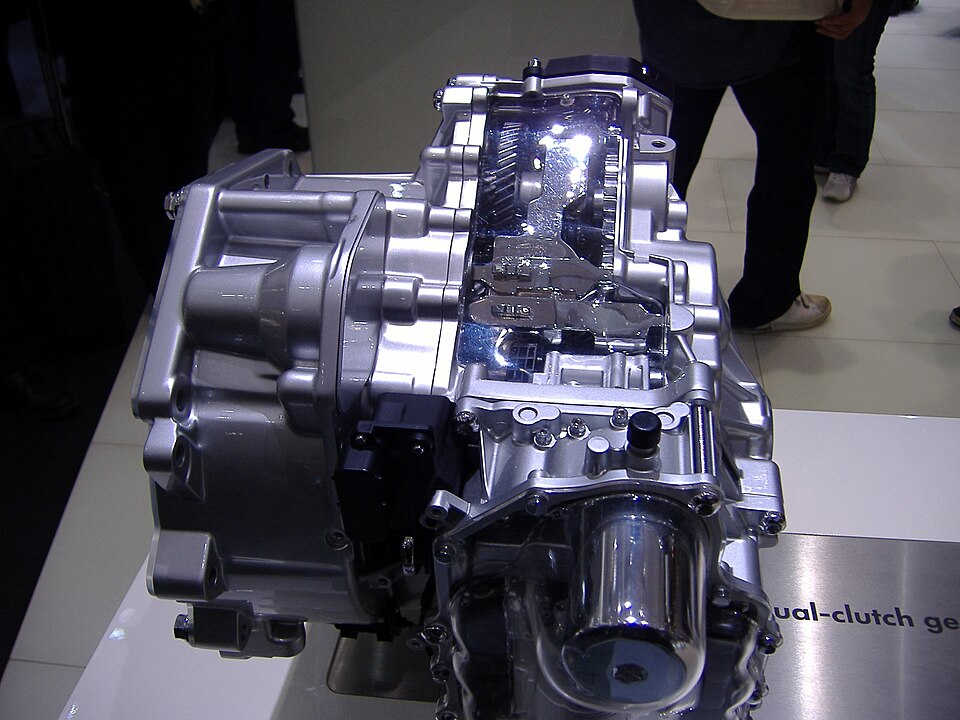
DSG clutch or mechatronic fault: why symptoms overlap
A judder when pulling away, a hesitant change or a gearbox warning can leave you facing the same question: is the clutch worn, or has the mechatronic unit failed? The symptoms alone rarely settle it. These components work together, so a problem in one part of the system can affect how another behaves.
At Trescothick Automotive in Bristol, we approach DSG and S tronic diagnosis by establishing what is happening before recommending parts. We combine diagnostic equipment with practical testing.
Two clutches, one coordinated handover
A DSG combines two gearbox sections, each connected to the engine through its own clutch. During a change, drive transfers between them. The mechatronic unit coordinates that process using electronics, sensor information and hydraulic actuation.
The clutch and its control system therefore answer different questions. Can the clutch transmit drive correctly? Can the gearbox control its engagement correctly? A poor handover is the result you feel from the driver’s seat; it does not identify which part caused it.
For a closer look at the control unit itself, read our guide to how a mechatronic gearbox works.
What the symptoms can tell us
Judder when pulling away
Judder makes the clutch system worth investigating, but it is not enough to order a clutch pack. The engaging mechanism, its adjustment and the way engagement is controlled also matter. The useful question is when the judder occurs and whether the workshop findings explain that particular behaviour.
Engine speed rises without the expected acceleration
This can raise suspicion of clutch slip. It still needs to be assessed against the gearbox type, operating conditions and diagnostic findings. A description such as “it slipped once” gives the technician a starting point; it is not a measurement of remaining clutch life.
Delayed engagement, harsh changes or missing gears
These symptoms can direct attention towards gearbox control, hydraulic pressure, sensors or actuators. Mechanical faults can also affect gear selection. Our mechatronic failure symptoms guide explains why several apparent warning signs can overlap.
Rattling or vibration
A noise near the gearbox is not automatically an internal gearbox failure. The dual-mass flywheel and surrounding components deserve consideration too. Locating the source is more useful than replacing the component nearest to where the driver thinks the sound comes from.
For a model-specific discussion of flywheel noise and overlapping symptoms, read Audi A3 dual-mass flywheel rattle. A rattle or vibration still needs testing before a flywheel or clutch repair is recommended.
Why the exact gearbox matters
“Seven-speed DSG” is not a complete gearbox identification. DSG designs include both wet and dry clutches, with different hardware and repair requirements. Advice intended for one version should not be transferred to another simply because the badge or number of gears matches.
Our separate guides cover DQ200 mechatronic problems and DQ381 mechatronic problems. Identifying the fitted transmission comes before applying a test procedure or interpreting its results.
What a useful diagnosis should establish
The conditions behind the complaint
Tell us whether the problem appears from cold, after warming up, while manoeuvring or during a change. Previous gearbox work and the service history are useful too. You do not need to reproduce a dangerous fault or perform your own tests; describe what you have already noticed.
What the diagnostic record actually says
A fault code records a condition the system detected. It is a clue to investigate, rather than automatic proof that a named assembly needs replacing. Relevant readings and physical checks should be considered together. Equally, an empty fault memory does not make a mechanical complaint disappear.
Whether the proposed repair explains the evidence
A sound recommendation should connect the complaint, the findings and the work proposed. If the concern is clutch wear, what supports that conclusion? If it is a mechatronic fault, what evidence points towards the control unit? If further investigation is required, that should be made clear before the scope of work grows.
This is why our vehicle diagnostics service includes practical investigation rather than treating a scan report as a parts list.
Will a reset or adaptation fix it?
Basic settings can form part of the correct procedure after clutch work. They are not evidence that worn or damaged components have become sound again. Whether a setting procedure is appropriate depends on the identified gearbox, the fault and the manufacturer’s requirements.
“It needs an adaptation” and “the clutch needs replacing” are both conclusions that should be supported, not guesses to try in sequence at the customer’s expense.
Choosing the repair on evidence
Clutch replacement and mechatronic repair address different faults. Neither should be sold as a universal cure for every DSG complaint, and replacing both needs its own justification. Once the cause is established, the available options can be explained against the condition of the vehicle.
Our guide to mechatronic repair or replacement covers that next decision. The first step is to find out which problem you actually have.
Useful Links
- Volkswagen technical glossary — DSG operation
- Schaeffler LuK — Volkswagen dry double-clutch technical guide (PDF)
Image source: peek-poke, DSG gearbox cutaway showing internal gears and clutch components, CC BY-SA 3.0. Unmodified photograph; this is an illustration and does not establish a fault.
