
What does wet or dry mean in a DSG?
“Wet” and “dry” describe how the gearbox’s clutch packs operate. A wet clutch runs in oil; a dry clutch operates without being immersed in an oil bath. That difference affects how the clutch is designed and managed, but it does not tell you everything about the gearbox or prove which unit is fitted to a particular car.
DSG and S tronic cover several transmission families. At Trescothick Automotive in Bristol, Neil uses the vehicle’s exact gearbox details, diagnostic information and practical testing to guide a repair.
Two ways to manage clutch engagement
A dual-clutch transmission has two clutch paths so one gear can carry drive while the next gear is prepared. The control system coordinates the handover. The clutch design is one part of a larger system that also includes gearsets, sensors, actuators, lubrication and electronic control.
In a wet-clutch design, friction plates operate in oil. The oil helps manage heat and is part of the clutch’s operating environment. In a dry-clutch design, the clutch plates are not immersed in an oil bath. “Dry” does not mean the whole gearbox contains no oil or fluid: the gears and other systems still need their specified lubrication, and some designs use separate fluids for different functions.
Wet and dry are design choices, not quality grades
Wet clutches are often selected for applications where the design needs to manage greater heat and load. Dry clutches can reduce drag losses in suitable applications. Those are broad engineering considerations, not a promise that one type is always stronger, more reliable or cheaper to maintain.
The complete transmission design matters: clutch dimensions and materials, cooling, vehicle mass, engine output, control strategy, packaging and intended use all play a role. A gearbox family cannot be judged from “wet” or “dry” alone.
Examples across the DSG range
The DQ200 is a familiar dry-clutch DSG family. The DQ250 is a well-known wet-clutch family. Other DSG and S tronic families use different layouts and versions. A seven-speed label does not establish clutch type: there are both dry and wet seven-speed designs. Check the exact transmission family and code rather than generalising from gear count or vehicle badge.
Our guides cover DQ200, DQ250, DQ381 and DQ500. The gearbox identification guide explains how to confirm what is in a specific car.
How the difference affects servicing
Do not assume every DSG has the same oil, filter or service interval. Wet-clutch gearboxes may have scheduled oil and filter requirements, while other DSG designs have different lubrication arrangements and maintenance instructions. Even within a broad family, exact requirements depend on the installed gearbox code and vehicle specification.
Using the wrong fluid or applying another gearbox’s schedule can cause problems. A history entry that simply says “DSG oil changed” may not tell you which specification or procedure was used. The vehicle’s technical data and service record should be checked together.
What the clutch type means when a fault appears
It helps the technician choose relevant information and tests; it does not diagnose the complaint. Shudder, hesitation, harsh engagement or a warning message may involve clutch wear, adaptation, mechatronic control, sensors, wiring or mechanical components. A symptom that feels similar across two cars can have different causes because the gearbox designs differ.
A scan code is a direction for further investigation, not proof that a clutch or mechatronic unit has failed. Diagnosis should connect the driver’s complaint with vehicle-specific data and practical test results. Read our guide to mechatronic symptoms for examples of why signs can overlap.
Hybrid DSG systems need their own identification
Some plug-in hybrid models combine an electric motor with a dual-clutch transmission. Their architecture and control strategy differ from a conventional petrol-only DSG, so do not infer the clutch or service arrangement from a familiar brand name. Identify the exact vehicle and transmission first. Diagnosis of high-voltage components requires appropriate specialist competence; this guide is not a repair instruction.
The useful takeaway
Wet versus dry describes the clutch’s operating arrangement. It does not identify every gearbox component, set a universal service interval or explain a fault by itself. Confirm the gearbox family and code, then use the requirements and test information for that exact unit. For help with a DSG or S tronic concern, see our diagnostic service.
Useful Links
- Volkswagen Vans UK — DSG transmission oil and filter checks
- Škoda technical overview — DQ200 seven-speed DSG (PDF)
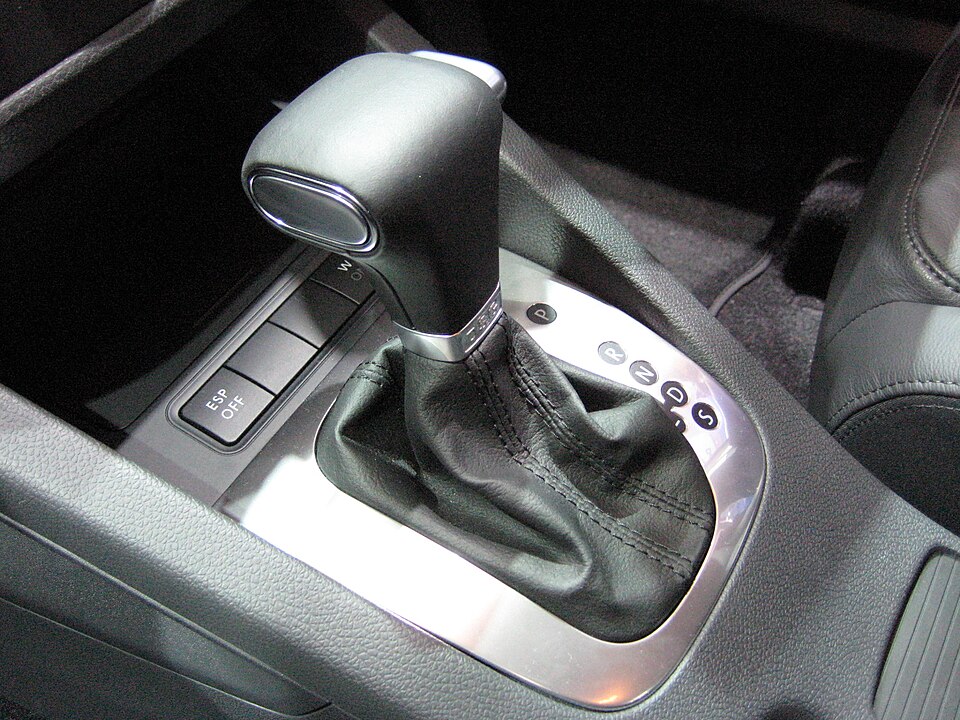
Image source: Hatsukari715, Volkswagen six-speed DSG gear selector and shift positions, Public domain. Unmodified photograph; this is an illustration and does not establish a fault.
